
Peer Reviewer Process
Jurnal Kepariwisataan implements a double-anonymized peer review process, ensuring that the identities of authors and reviewers are concealed throughout the review process.
Double-Blind Review Policy
To ensure fairness and objectivity:
Authors and reviewers remain anonymous to each other
Authors must remove all identifying information from the manuscript
Self-references should be written in the third person
Manuscripts are evaluated based on academic quality, originality, and relevance to tourism and hospitality management.
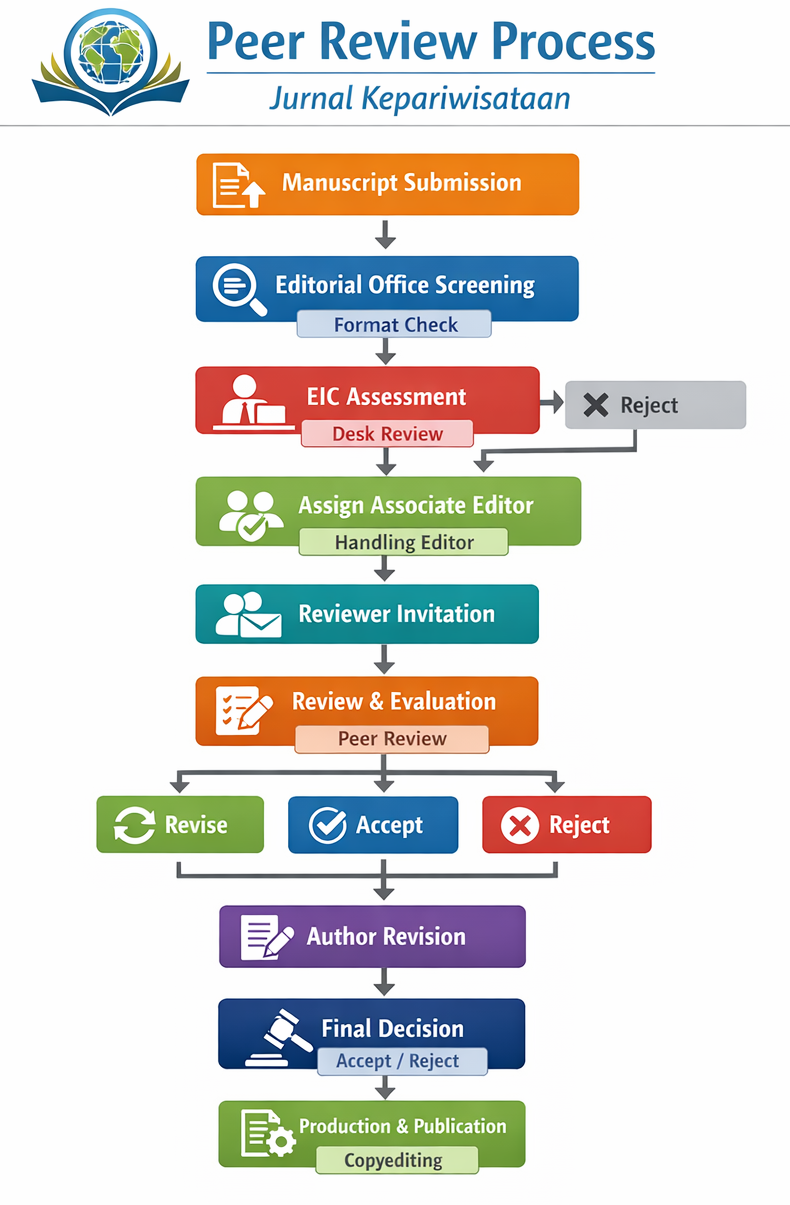
1. Submission of Manuscript
The corresponding author submits the manuscript through the journal’s online submission system. Authors must upload two separate files: 1. Title Page (author details, affiliations, acknowledgements, conflict of interest), 2. Anonymized Manuscript (without any identifying information). Manuscripts that do not comply with anonymization requirements will be returned before review.
2. Editorial Office Screening
The Editorial Office conducts an initial screening to ensure that the manuscript follows the Author Guidelines, required documents are complete, the manuscript is properly anonymized for double-blind review, and the submission fits the journal’s format and structure. At this stage, scientific quality is not yet evaluated.
3. Desk Review
The Editor-in-Chief evaluates the manuscript based on scope and relevance to the journal, originality and novelty,theoretical and methodological contribution, overall academic merit. Based on Editorial desk review the manuscript may be: Rejected (desk rejection), or sent for peer reviews.
4. Assignment to Associate Editor (Handling Editor)
If suitable for review, the EIC assigns an Associate Editor (AE) or Handling Editor. The Handling Editor is responsible for managing the peer review process, selecting qualified reviewers, making recommendations based on reviewer feedback.
5. Reviewer Invitation
The Handling Editor invites at least two independent reviewers with expertise in the relevant field. Additional reviewers may be invited if invitations are declined, reviews are delayed, or additional opinions are needed.
6. Reviewer Response
Invited reviewers evaluate the invitation based on subject expertise, availability, potential conflicts of interest. Reviewers may accept the invitation or decline and optionally suggest alternative reviewers.
7. Peer Review Process
Reviewers evaluate the manuscript through multiple readings, consist of:
First Reading
Assess overall relevance and contribution
Identify major flaws or suitability
Detailed Review
Theoretical framework
Research methodology
Data analysis and validity
Contribution to tourism and hospitality knowledge
Provide constructive, point-by-point feedback
Reviewer Recommendation
Reviewers submit one of the following recommendations:
Accept
Minor Revision
Major Revision
Reject
8. Editorial Evaluation of Reviews
The Handling Editor reviews all reviewer reports and assesses consistency among reviewer recommendations; Evaluates the strength of arguments. If reviewer opinions differ significantly, the editor may invite an additional reviewer, or make a decision based on editorial judgment.
9. Decision Communication
The editorial decision is communicated to the author, including anonymized reviewer comments. Possible decisions:
Accept
Minor Revision
Major Revision
Reject
Reviewer identities remain confidential under the double-blind review model.
10. Revision Process
If revision is required, authors must submit a revised manuscript include a response to reviewers explaining changes made For:
Major revisions → manuscript may be re-evaluated by reviewers
Minor revisions → may be assessed by the Handling Editor
11. Final Decision
After revision, the editor makes the final decision:
Accept for publication
Request further revision
Reject
12. Production and Publication
Accepted manuscripts proceed to copyediting process follow by layout and proofreading and final online publication
13. Reviewer Notification
Reviewers are informed of the final decision. If applicable, reviewers may be invited to review revised versions, and acknowledged for their contribution.